
Company data licensing can be approached with defined boundaries: a chosen scope, a known recipient, agreed uses, and a preparation process your team reviews. The question is not whether every record is safe to sell. It is whether a specific set of records can be used for a specific purpose on acceptable terms.
For an owner considering the revenue opportunity, a sensible review protects the business without turning an initial inquiry into months of unnecessary work. Avelence starts with a company profile, not access to its operating systems.
What are the main risks?
Most practical concerns fall into five areas. Treat them separately so the response fits the problem.
| Concern | What the company needs to establish | A practical response |
|---|---|---|
| Personal information | Whether individuals remain identifiable and what use is proposed | Review the fields, recipient, legal basis, minimization, and safeguards |
| Customer confidentiality | Which promises cover client information and project materials | Separate restricted material and review the applicable agreements |
| Intellectual property | Who can authorize use of documents, code, and other protected material | Check authorship, contracts, third-party inputs, and licensed components |
| Competitive exposure | What the archive reveals about strategy, methods, or sensitive operations | Define exclusions and permitted uses before agreeing the scope |
| Commercial lock-in | Which other opportunities the agreement restricts | Compare exclusivity, term, onward rights, and continuing obligations |
These are commercial scoping decisions as well as review questions. An archive can contain relevant material alongside material that should not be included.
Does removing names solve the privacy problem?
Not necessarily. A rare job title, a detailed incident, a combination of dates, or a distinctive customer situation can identify someone without stating a name.
The ICO distinguishes pseudonymisation from anonymisation. Replacing a name with a code does not automatically make information anonymous; identifiability depends on the circumstances and additional information available. Its guidance is currently under review, so the applicable requirements should be checked for the proposed deal. ICO guidance on pseudonymisation.
The practical response is to define a preparation and review process, not rely on the label "anonymized." Ask what is removed or transformed, who can see the original, what a buyer receives, and how the output is checked.
How can the company keep customer material separate?
Start with categories rather than selecting every file in a workspace. Internal procedures, employee-authored notes, customer messages, attachments, and deliverables can have different ownership and confidentiality conditions.
For example, a consultancy might retain its own reusable project checklist alongside a client-supplied financial model. Their presence in the same folder does not put them on the same footing. An internal note discussing a client may also remain sensitive even if the note was written by the consultancy.
The agency and consultancy guide explains a way to separate these categories before requesting a proposal.
Could a buyer reproduce the business or expose its advantage?
Your company should examine the proposed use, not rely on a broad assurance that a buyer has no interest in competing. Identify particularly sensitive playbooks, unreleased product plans, security information, and customer commitments.
A useful agreement defines the permitted activity, authorized recipients, any onward use, and restrictions that matter to your business. Your advisers should assess whether those provisions are meaningful and appropriate to the transaction.
A narrower first scope can be a practical option. For instance, the company might discuss completed, historical support-resolution work while keeping current product-roadmap discussions outside the proposed dataset. The buyer still needs to decide whether that scope meets its requirement.
What should happen before any records move?
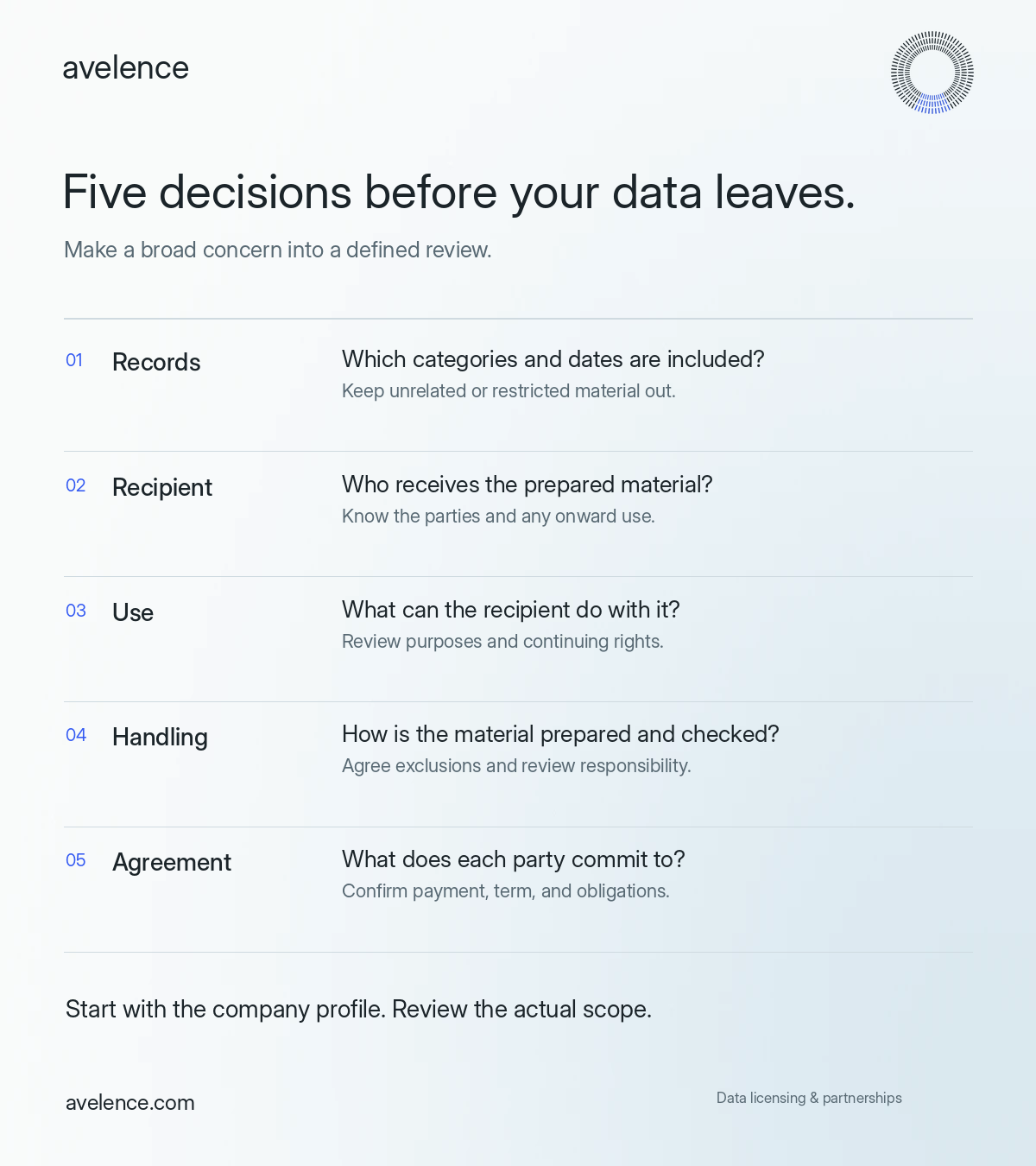
Agree the scope and responsibility for preparation. Identify the receiving parties and permitted use. Establish how personal information, confidential content, and third-party material will be handled. Confirm the review and approval of the prepared copy.
A compact decision sequence helps:
Describe the archive. Define the scope. Review the terms. Approve the prepared material.
This sequence lets the business discuss the opportunity at company level before exposing the records themselves. It also gives legal, security, and operations colleagues a specific proposal to review rather than an undefined request to approve "selling data."
Can the company withdraw later?
Read the termination and surviving-rights provisions before signing. Stopping future access, deleting a retained copy, and changing a model already developed using the records are different questions. The agreement should explain the obligations rather than leave the company to infer them from a general deletion promise.
Ask how a dispute, an incorrect inclusion, or a rights concern is handled. Who receives the notice? What action follows? What continuing uses or payments remain? These details belong in the review of a real proposal.
When should the company pause?
Pause the proposed scope when a material question is unresolved: no one can authorize the use, customer agreements appear to prohibit it, a recipient is unclear, the requested records include active security issues, or the parties cannot explain how payment and acceptance work.
Pausing a scope is not the same as abandoning the entire opportunity. A different record category, narrower period, or better-defined use may support a more workable discussion. It should be evaluated on its own merits.
Where does Avelence help?
Avelence helps identify relevant records, match the business with suitable buyers, and organize the commercial discussion. The company retains its decision about which opportunity to pursue and what material to include.
The first company profile needs systems, history, business context, and a relevant contact. It does not require a data upload. When a specific opportunity develops, the selected partner and your team agree the detailed scope and handling process.
Start by understanding the opportunity. Decide what to share against an actual proposal.
Common questions
Can anonymized records still identify people?
Some de-identified records can be re-identified. NIST's research review describes that risk and why techniques need to be assessed in context. NIST de-identification research.
Does an NDA let us license everything in a system?
No. Confidentiality terms address disclosure and use between parties. They do not themselves establish all the rights needed to license third-party material or satisfy every obligation applying to personal information.
Does the company have to share its whole archive?
A licensing discussion can define a particular scope. Whether that scope is commercially suitable depends on the buyer's requirement. Begin with the records you can describe and the boundaries your business needs.