
A company data license pays according to its agreement, not a universal industry countdown. The most useful question is: which event makes our payment due, who confirms that event, and how long after it must the money arrive?
A proposal may pay at signing, accepted delivery, completed onboarding, or a later licensing event. These can produce very different timelines even when the headline amount is the same.
For a company considering the opportunity, Avelence helps organize the route to a relevant buyer. The payment schedule then needs to be explicit in the resulting deal.
What happens between the first inquiry and a payment?
Think of two clocks. The first is the time required to get a company to an agreed proposal. The second begins when the contract's payment conditions are satisfied.
| Stage | What moves it forward | What can hold it up |
|---|---|---|
| Company profile | Clear systems, history, business context, and a responsible contact | Missing or inconsistent basic information |
| Buyer fit | A relevant use and a plausible scope | A mismatch between the archive and the buyer's task |
| Scope and terms | Agreement on records, rights, handling, and economics | Unresolved permissions, exclusions, or responsibilities |
| Preparation | Completion of the agreed dataset or other contribution | Unexpected gaps, export issues, or review work |
| Acceptance | Confirmation against stated criteria | Open-ended review or disagreement about deliverables |
| Invoice and payment | Correct invoice, payee details, and a payment obligation | Administrative errors or dependencies on other receipts |
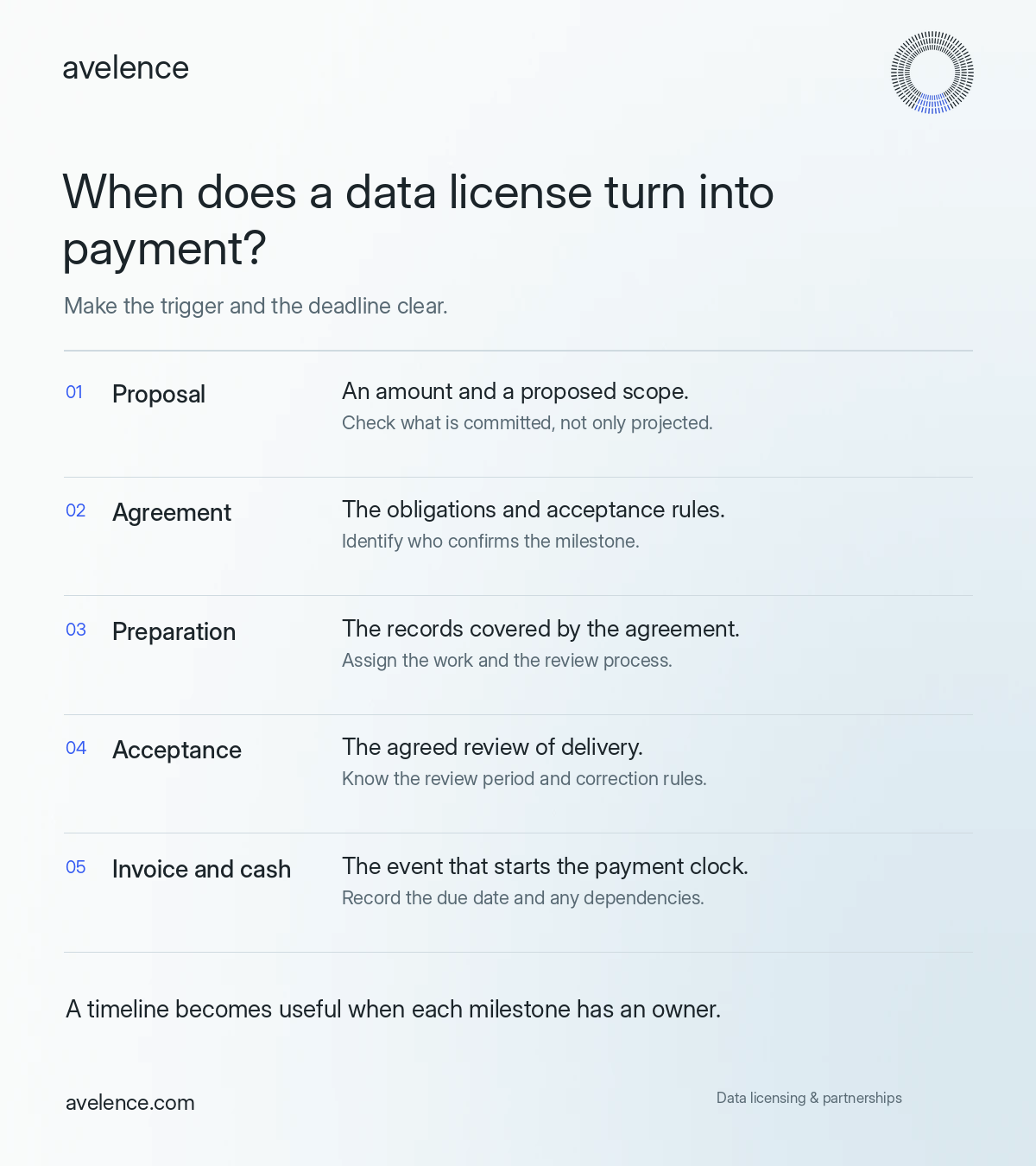
No single stage proves the next has happened. A positive call is encouraging, but the finance team still needs to know what the agreement commits to.
What should a payment clause make clear?
Ask for the trigger, deadline, payer, currency, acceptance process, deductions, and invoicing requirements. A written schedule should be understandable without relying on a verbal assurance.
Compare these fictional formulations:
Unclear: "Payment follows successful onboarding."
Clearer commercial question: "What constitutes completed onboarding, who confirms it, when must they respond, and how many days after that confirmation is payment due?"
The second does not choose a legal clause for the parties. It identifies the missing operational facts that make the promise assessable.
Why does acceptance matter so much?
If payment depends on accepted delivery, the company needs to understand what acceptance means. Establish the agreed fields, scope, quality checks, review period, correction process, and treatment of a partial delivery.
A broad phrase such as "satisfactory data" can leave both parties with different expectations. A clearer description helps the company plan the work and reduces the risk of repeated preparation without a shared completion standard.
The buyer also benefits. A defined scope makes it easier to tell the supplier what is missing and decide whether the material meets the agreed use.
How do recurring payments change the timeline?
Recurring structures add a reporting clock. The company needs to know when eligible receipts are calculated, when reports are issued, which deductions apply, and when the resulting share is paid.
A revenue share based on money collected from downstream users differs from a payment due simply because the company supplied an update. Do not treat a forecast, a sale, an invoice, and a receipt as the same event.
The upfront versus recurring guide includes a worked comparison of fixed and contingent economics.
Can the company make the process faster?
It can reduce avoidable delays without bypassing necessary review. Identify the internal owner, document approximate retained periods, and flag known contractual restrictions early. Bring the relevant systems lead into the discussion when the scope becomes concrete.
Keep basic company information consistent across the profile, agreement, invoice, and payee details. Avoid preparing a large export before the buyer has said which material it needs.
Also separate a short commercial description from a comprehensive inventory. The first should help qualify a discussion. A detailed technical inventory belongs where it serves an actual requirement.
What should the finance team track?
Use a small milestone ledger with the agreement reference, trigger, evidence of completion, date confirmed, invoice date, due date, payer, and received amount. Avelence's introduction updates can support the conversation, but the company's payment record should follow the agreement.
For a fictional deal, the critical record might be: "Dataset accepted in writing on 4 November; invoice issued 5 November; agreement requires payment thirty days from valid invoice." That tells the team when to follow up. "Partner liked the data" does not.
Dates in this example illustrate tracking, not typical processing times.
What if payment depends on a further sale?
Ask whether there is a minimum commitment, how a sale is allocated to your dataset, what reporting you receive, and what happens if no sale occurs. Determine whether you must keep supplying updates while waiting and whether the arrangement limits other licensing options.
A company can accept contingent economics deliberately. The problem is mistaking contingent upside for committed cash. Compare the work, restrictions, and potential return on the same basis.
What is the practical next step?
Begin with a relevant buyer and a scope your company can provide. Then agree a payment path that names the event and deadline rather than promising that the process is fast.
Avelence helps businesses reach that conversation by organizing the company profile and matching it to appropriate data requirements.
Find buyers for your company data.
Common questions
Does signing a license mean payment arrives immediately?
Only if the agreement makes it payable then. Many proposals attach payment to another condition. Read the trigger and due date together.
Is the referral reward part of the company's licensing payment?
It is a different commercial arrangement. The company should understand its own payment and any relevant intermediary compensation without assuming the two amounts are interchangeable.
Can a buyer pay for only part of the proposed archive?
The parties can agree a narrower scope or an acceptance process covering defined parts. The payment and treatment of any excluded material should be clear in the agreement.