
Avelence helps AI teams and data-partnership businesses find companies with relevant operational histories. Start with the task your model needs to perform, then specify the records and company profiles that can supply evidence of that work.
A request for "enterprise data" is too broad to guide sourcing. A request for completed support investigations with linked escalation decisions and resolution outcomes is something a sourcing team can act on.
This guide is for data acquisition, research, product, and partnership teams looking for company records to license, rather than a workforce to label data they already have.
Discuss a sourcing requirement with Avelence.
What should the sourcing brief specify first?
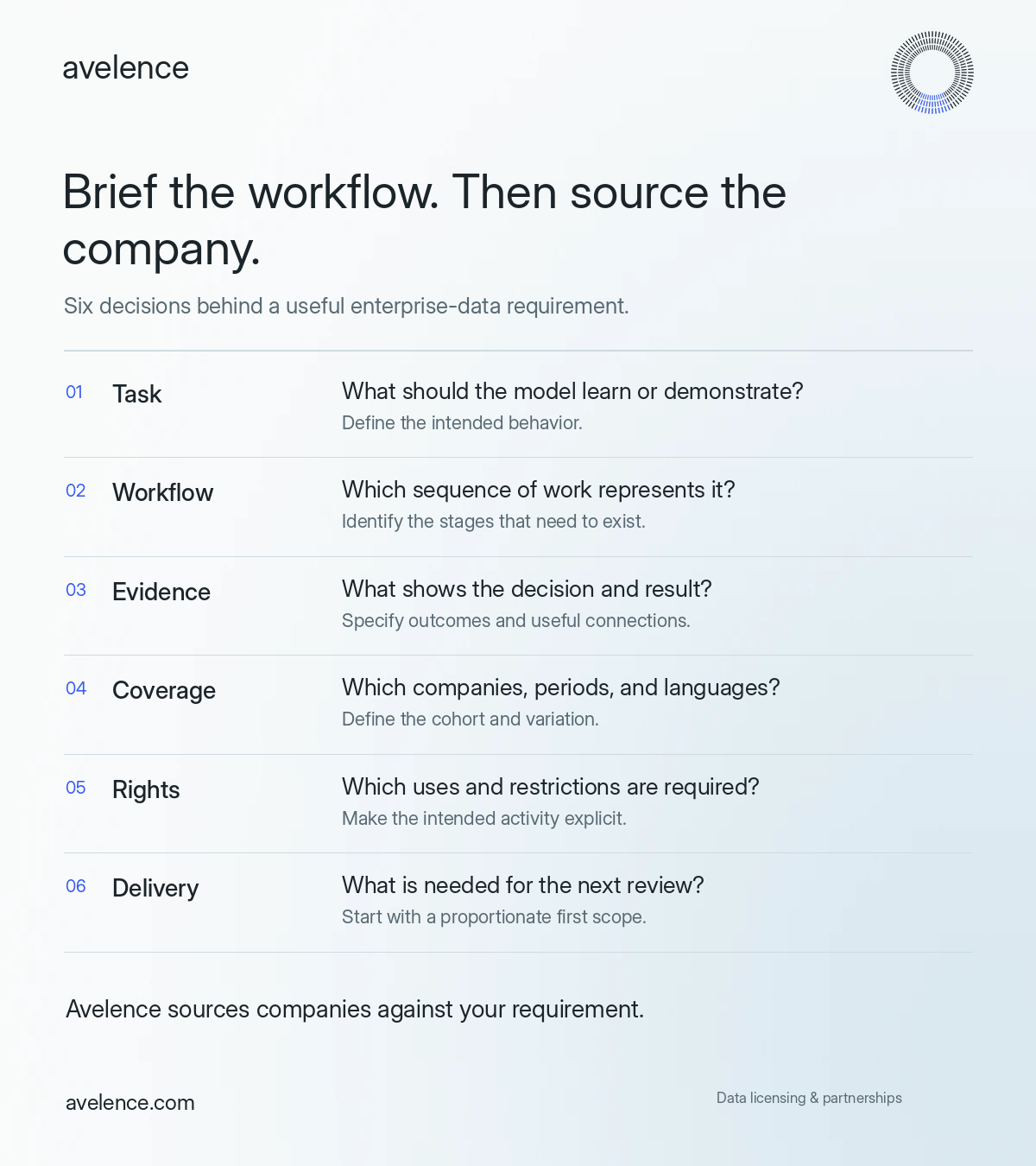
Start with six decisions. They narrow the search without pretending that a company name or software stack proves dataset suitability.
| Decision | What to specify | Example |
|---|---|---|
| Task | What the model should learn or be evaluated on | Resolve an invoice discrepancy |
| Workflow | The sequence of work represented | Inquiry, account review, escalation, correction, confirmation |
| Evidence | What records show the decision and result | Internal notes, linked issue, adjustment record, resolution |
| Coverage | Company types, retained periods, languages, and regions | A defined cohort with a relevant operating history |
| Rights | Proposed uses and any required restrictions | Training and held-out evaluation considered separately |
| Delivery | The scope and format needed for a first evaluation | A scoped sample under agreed terms |
The initial brief can describe these decisions without revealing proprietary model details. More sensitive technical requirements can be discussed through the appropriate process.
Why source workflows rather than only systems?
A tool tells you where records may live. A workflow tells you what the records need to explain.
A company can use a ticketing system and still retain little useful investigation history. Another may link each escalated issue to a decision, a change, a test, and a confirmed outcome. Both have the same category of software, but their potential contributions differ.
For sourcing, define the minimum useful sequence. Then identify the systems likely to contain its parts. Ask whether the links and timestamps survive, which stages are missing, and which team can verify the description.
This produces a better initial company profile than a long checklist of application logos with no explanation of what happens inside them.
How should training and evaluation requirements differ?
For training, a buyer may want the complete record of a task, including decisions and outcomes. For evaluation, the design may require separating what is available at the start from the answer revealed later.
For example, an evaluation of invoice-discrepancy resolution should not accidentally give the tested model the final correction in its input. The scikit-learn documentation explains the broader problem of data leakage and overly optimistic evaluation when information unavailable at prediction time influences the process. Common pitfalls: data leakage.
That leads to sourcing questions: can the records be partitioned by time, company, case, or workflow? Can related copies be identified? What was available before the decision? The right split depends on the evaluation design, not a universal rule Avelence imposes.
Which company characteristics are useful filters?
Prioritize the characteristics that affect the task: industry, business model, team responsibilities, workflow volume, retained history, language, and record completeness. Company size and software usage are useful screening inputs, not final quality judgments.
Different tasks may require different cohorts. A broad assistant may need varied companies and workflows. A specialist evaluation may need a much narrower operating context. Specify what should vary and what must remain comparable.
Also distinguish live businesses, historical archives, and ongoing contributions. They create different commercial and preparation requirements. A company willing to license a defined archive may not want a continuing data-production obligation.
What should arrive with a qualified company introduction?
The first packet should help the buyer decide whether to scope the opportunity. It should cover the business, relevant workflow, systems and retained history, an appropriate contact, known restrictions, and unanswered questions.
It should also make the evidence level clear. A statement confirmed by the systems lead is different from a respondent's initial estimate. Avoid filling those gaps with invented precision.
Detailed provenance, sample quality, and license terms are then reviewed against the proposed dataset. A useful company introduction makes that review more focused; it does not replace it.
Use the buyer sourcing brief to give Avelence a concrete requirement.
How can a buyer avoid costly mismatches?
Agree acceptance criteria before making broad requests. A source may have the relevant workflow but not retain the necessary outcomes. Another may have the records but cannot grant the uses the buyer needs. A third may meet both conditions but require preparation beyond the available budget.
Separate those reasons in the feedback. "Not a fit" teaches a sourcing team very little. "Missing resolution outcomes" or "requested use is outside the proposed rights" improves the next search.
Avelence can align company qualification with these requirements and use feedback to refine sourcing. That is more useful than treating every business with a particular application as an interchangeable lead.
What should happen after the introduction?
The buyer and company agree the next scoping step, the information required, and the appropriate protections. A sample or dataset transfer should follow a defined purpose and review process.
The buyer should assess data suitability and provenance before committing the records to its intended use. The company should understand the scope, compensation, and participation requirements.
These responsibilities can be coordinated without forcing every discussion through a long intermediary discovery call. A complete, relevant profile gives both teams a better starting point.
How does Avelence fit into the sourcing process?
Avelence researches and qualifies businesses against the agreed company and workflow profile, then coordinates the introductions they approve. Your team specifies what constitutes a useful source and makes the downstream technical and commercial decisions.
Bring the requirement. Avelence helps find the companies whose work can meet it.