
Avelence helps companies find buyers for operational data. It connects businesses with relevant AI-data opportunities, organizes the company profile, and coordinates the commercial introduction.
For a business owner asking where to sell company data, the useful starting point is not a directory of AI companies. It is a clear description of what the business can offer and which kind of buyer needs it.
You can begin with an indicative estimate, then submit one company profile. Avelence helps identify the opportunities that fit the records, rather than leaving your team to repeat the same discovery process across unrelated platforms.
Which route fits your business?
Companies can approach a known buyer directly, use a marketplace, or work with a service that sources relevant buyers and coordinates introductions. The right route depends on how prepared the dataset is and how much of the commercial work the company wants to handle itself.
| Route | Best suited to | Work your team should expect |
|---|---|---|
| Direct conversation | A company that already knows a relevant buyer and its requirement | Explain the scope, qualify the interest, and manage the proposal process |
| Dataset marketplace | A company with a defined product and the capacity to maintain a listing | Package the offer, provide documentation, and handle buyer evaluation |
| Sourcing and introduction service | A company with useful operating history that needs help reaching relevant buyers | Describe the company, confirm the records, and participate in the opportunities selected |
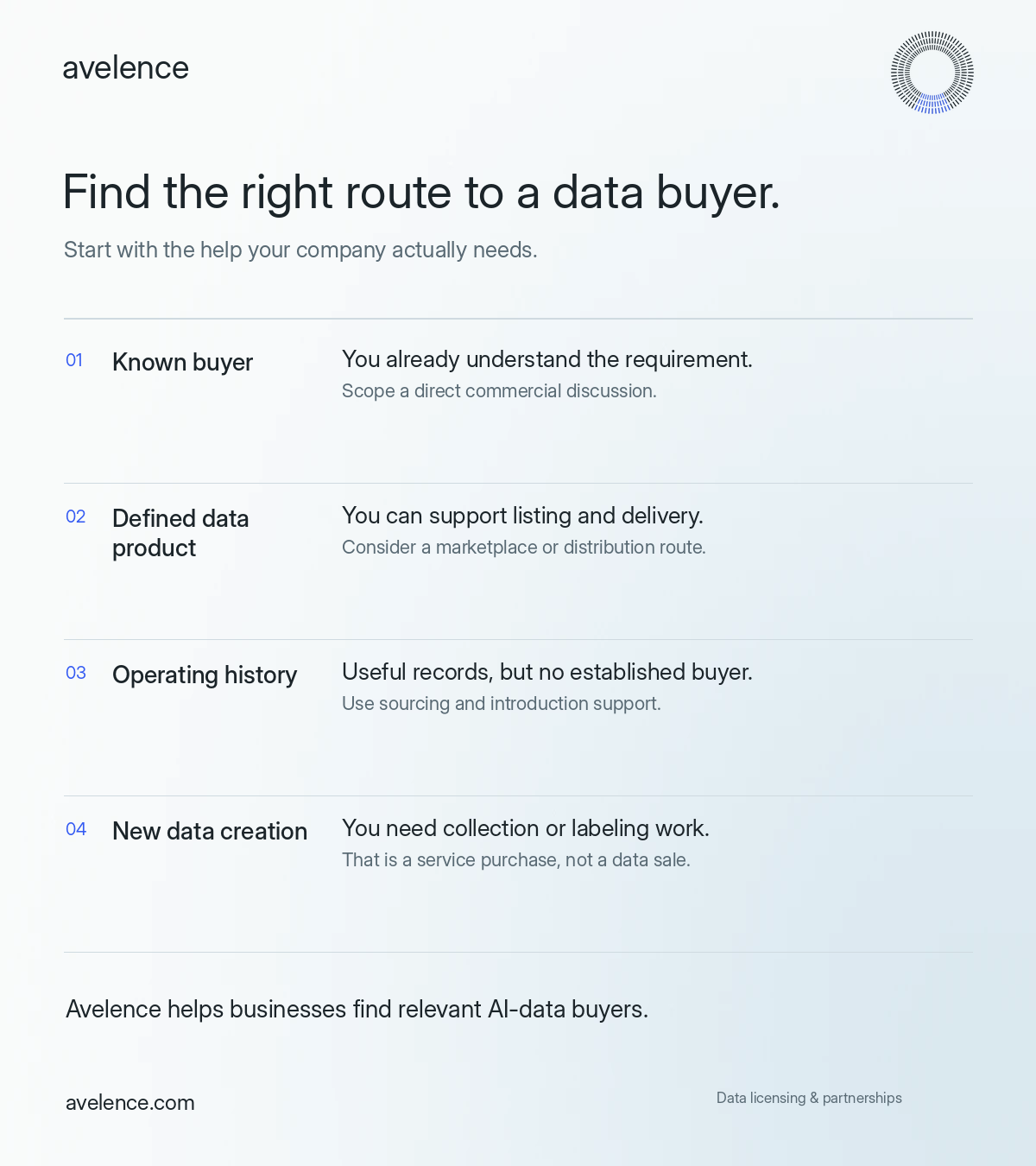
Avelence serves the third route. The company does not need to turn itself into a data vendor before finding out who is interested.
What kind of data do you want to sell?
Be clear about the distinction between a business contact list and operational history. Avelence focuses on the record of work: support resolutions, sales activity, project decisions, engineering history, internal documentation, and related workflows.
This distinction matters when searching. "Buy business data" can mean buying prospect contacts. "AI training data" can mean paying workers to create or label new examples. Neither necessarily matches a company seeking revenue from records it already holds.
A useful description names the workflow and available history. For example: "Our service team retains equipment-troubleshooting notes, escalation histories, and the procedures updated after a repair." That gives a prospective buyer more context than "we have a large database."
See the company-data categories for the records to look for in familiar systems.
How do you know a buyer is a good fit?
There are three practical tests.
The data fits the task. Ask what the buyer needs the records to help a model learn or evaluate. A buyer seeking customer-service decisions may not need a complete finance archive. A buyer evaluating engineering work may need issue history, not just the latest source-code snapshot.
The proposed scope is workable. Your team can identify the relevant records and review whether they can be used as proposed. Unnecessary data collection and a poorly defined scope make a deal harder to complete.
The commercial terms suit the company. Consider payment, preparation work, continuing contributions, exclusivity, and permitted uses together. A website's largest advertised amount is not a proposal for your company.
Avelence uses these questions to narrow introductions. The aim is a relevant business discussion, not a long list of contacts.
What should a company ask before using an intermediary?
Ask the intermediary to explain its role plainly. Does it buy a license, distribute data, introduce buyers, prepare datasets, or provide some combination of those services? Then establish how it is paid and what your company is expected to do.
A useful first conversation should resolve these questions:
| Ask | A useful answer explains |
|---|---|
| What happens after the first profile? | Who reviews it and how a relevant next step is selected |
| Who receives our information? | The proposed recipient and the scope of the introduction |
| How are fees handled? | Who pays the intermediary and what requires a separate agreement |
| Are we committed to one route? | Any restrictions before or after a license is signed |
| Who handles data preparation? | The responsible party, process, and company review |
| What makes the company payment due? | The actual contractual milestone, not a vague promise |
Use the licensing questions checklist when a proposal develops.
What does your company need to prepare?
Start with the company website, industry, relevant systems, years of retained history, main regions and languages, and a contact who can move the discussion forward. Note important previous licenses or restrictions.
Exact record counts can come later when a buyer needs them. You do not need to supply customer messages, private repository links, access tokens, or raw exports to describe the opportunity.
The company profile worksheet helps an owner collect the context from support, sales, engineering, or operations leads. It stays a short commercial overview, not a second project to complete before applying.
How does Avelence get the company to a deal?
Avelence organizes one company profile, identifies relevant buyer requirements, and coordinates the introductions the company approves. The buyer and company then discuss scope, preparation, rights, and the proposed payment.
Where there are different suitable routes, the company can consider the commercial differences before choosing. Avelence keeps the discussion focused on opportunities appropriate to the records and the business's priorities.
Submitting the initial company profile is free. Avelence can receive compensation from a data partner for a successful introduction. That relationship is explained before the introduction; any company-paid additional work requires a separate agreement.
What is the best first step?
Get a starting estimate and describe the operating history your company actually retains. That gives the opportunity a commercial frame and gives Avelence the information needed to find relevant buyers.
You already have a business to run. You do not need another business selling data.
Find buyers for your company data.
Common questions
Does Avelence buy the records directly?
Avelence connects businesses with suitable data buyers and coordinates introductions. The licensing proposal and agreement establish the party purchasing the rights and paying the company.
Can we approach a buyer ourselves?
Yes. A direct approach can work when the fit and process are already clear. Avelence is useful when the company needs help finding that fit and organizing a productive discussion.
Do we need a ready-to-sell dataset?
Not for the first company profile. Start with systems, retained history, and relevant workflows. Preparation requirements can be scoped around an actual opportunity.